

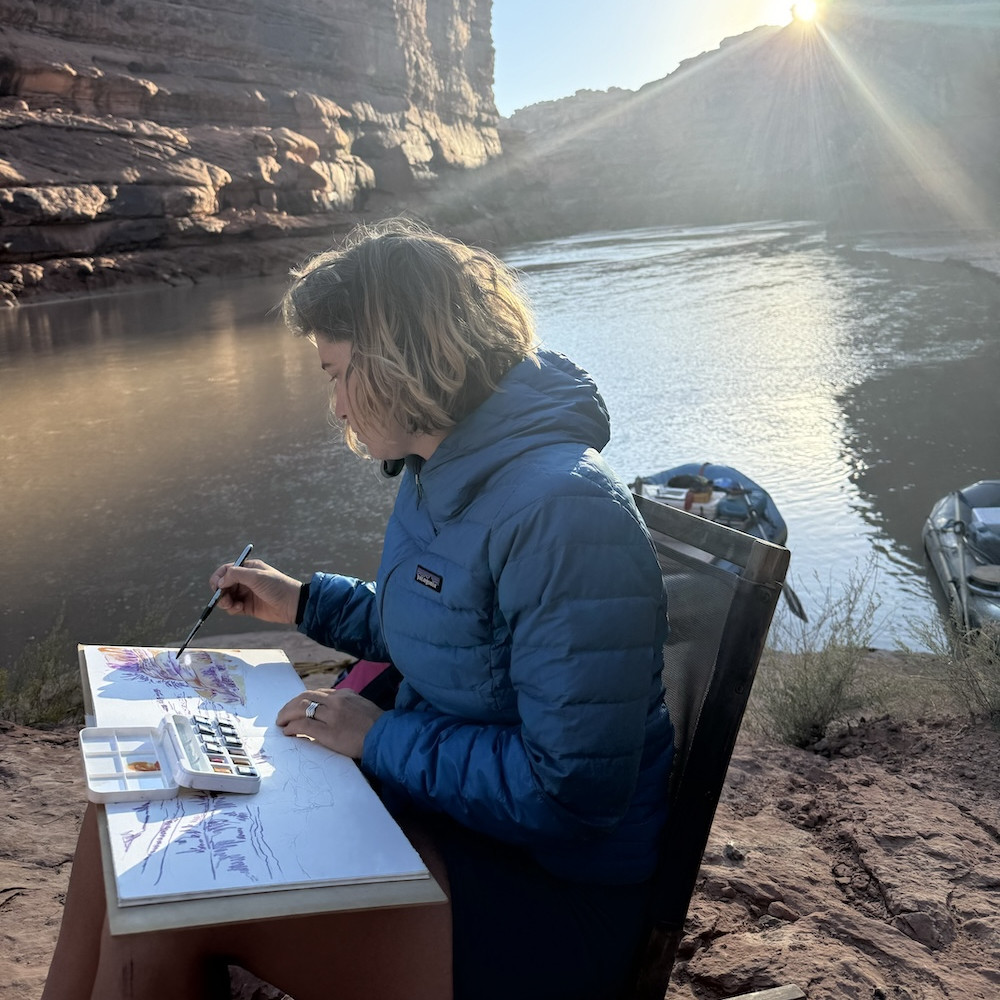
If you’ve spent any time in Bluff, Utah over the past few years, you’ve probably seen Kate Aitchison’s vivid, ecologically inspired artwork. Since joining the community in 2019, Aitchison has been inspired to create opportunities for artists in rural spaces, while creating work exploring the relationships between human interventions and natural landscape. The donor wall welcoming visitors on the front of the Bears Ears Education Center was designed by her and her husband, and we chose one of her pieces to help promote the 2026 Celebrate Bears Ears event. Aitchison also runs a small gallery in town, and organized the 2025 Bluff Arts Festival. Currently, she’s the Artist in Residence at The Nature Conservancy’s Dugout Ranch.
Communications Manager Amelia Diehl sat down with Kate back in late 2025 to learn more about her artistic process and how she is influenced by the Bears Ears landscape.
What is your connection to Bluff?
I’m from Flagstaff, Arizona originally, and have been coming to Bluff for a long time with my parents. My dad has always really liked this area, and I grew up coming here. Then I river guided here a little bit right after college. When I was going to graduate school in Providence, Rhode Island, I brought my partner at the time - now husband - to just show him the area. And he really liked Bluff. After grad school I was interested in coming back west, and this was the place that we landed on to come back to. We've lived here part time, on and off since 2019 and then moved here full-time three years ago in January.
How did you get into art?
My mom was a middle school art teacher, and my dad is a photographer and a naturalist, so it was always part of my life, ever since I was a little kid. I actually tried really hard not to be an art major when I went to college. There were lots of things I was interested in, but art was the thing that I just kept coming back to.
What mediums do you like to work with?
My primary mediums are printmaking and paper making, but I make a lot of monotypes. Mono means “one”, so that just means that if you're making monotypes, you're using printmaking techniques. In my case, I have an etching press, and so I make big stencils, but I don't try to make more than one of any certain print. I might use the stencil multiple times and have images that are similar to one another, but they're not multiples like a wood block would be. So usually I end up with a suite or a series of prints that might be related to each other, but none of them are the same.
And then I make pretty much all my own paper now. I use primarily invasive plant species to make paper, and I also use recycled textiles. I gather a lot of things from the laundromat here in Bluff from the free pile, but also get things from other people, and right now have amassed a pretty large scrap linen collection. Anything that's organic, in the sense that it's made of plants, can become paper. Cotton, linen, hemp, all can break back down into paper.
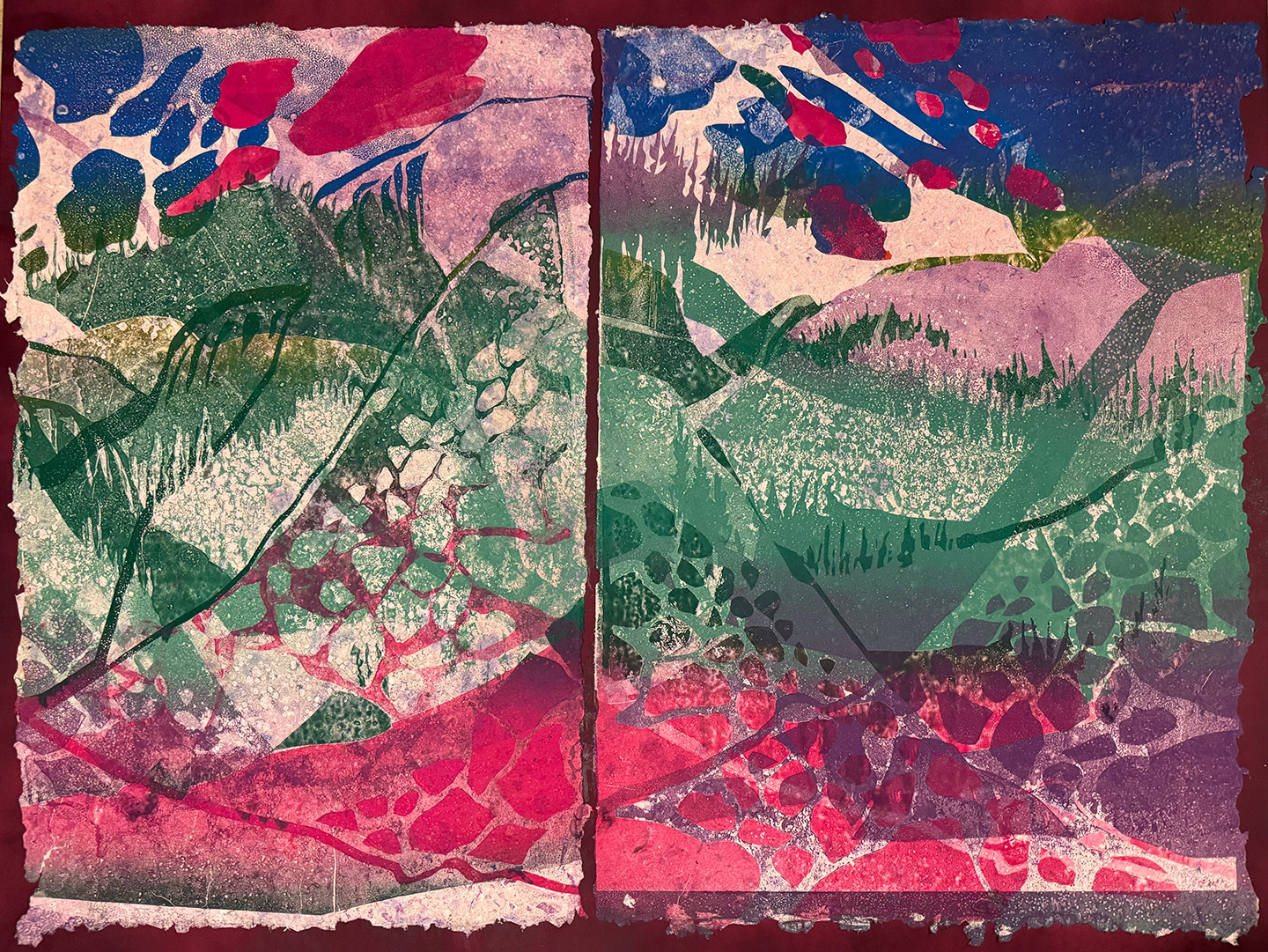 "Hesperus"
Tell me more about the plants you use to make paper.
There’s three main fiber types that you can make paper from: grass, big fibrous leaves, and bast fiber, which is the inner bark.
One of the things that I wanted to try when I first came to Bluff was working with mulberry. Mormon pioneers brought silk Mulberry here to see if they could start a silk industry, so there's a lot of remnant mulberries around. Some people love the mulberry trees here, some people hate them. That's an inner bark fiber, and it actually made really gorgeous paper.
Another plant that is actually one of my favorite plants to make paper out of is cheatgrass. You have to cook fiber to process it, and turn it into paper. So the seeds turn black when you cook them, and you get this golden paper with black seeds in it, which is really beautiful.
Tamarisk is not very tough - it doesn't have good fiber - so it doesn't make good paper on its own, and that was something that I experimented with. But if you mix it with another fiber, it makes the paper really beautiful, and has these little golden flecks.
I have also tried making fiber from agave. I got some fiber from an agave plantation in Mexico, because they end up with lots of leftover agricultural waste, and are trying to figure out what to do with it. And that makes really good paper because those fibers, as you probably know from like yucca sandals and yucca ropes that have been found in this region, those agaves in Mexico are related. That fiber is really tough and really strong, and it can also make good paper.
It’s been sort of an ongoing experiment, continuing to refine different fiber types. It's an interesting process to think about [making paper] as the building blocks for an artwork, rather than just using a piece of white paper to make something on.
How has the Bears Ears landscape influenced your work?
I got a grant right after grad school to come out here and figure out how to make paper out of invasive plant species. With one of the people in my cohort, we spent six weeks trying to make paper from things we had never made paper out of before. That was a huge jumping off point for me in terms of figuring out how paper could be also place-based – how using natural materials from specific places then makes that work about that place, whether or not it's super obvious.
I also worked as a river guide for a long time on the San Juan and the Colorado Rivers. Living in between these two rivers that come together in a confluence, not very far away from Bluff, certainly has a big influence on my work. There's just something really interesting to me about how things can continue to grow and flourish in such a harsh environment, the adaptations that occur, and the way the landscape forms because of the rocks and water and wind and weather and time. So there's this geology piece, there's this ecology piece, and then there's this like human intervention piece, like what we're doing to the landscape and how our actions influence the landscape, change it.
How does your creative practice influence how you relate to the landscape?
Pretty much anytime I'm going out, I'm looking for things that attract my attention or might be of interest to record in some way, whether that be the colors, the specific landscape or the clouds.
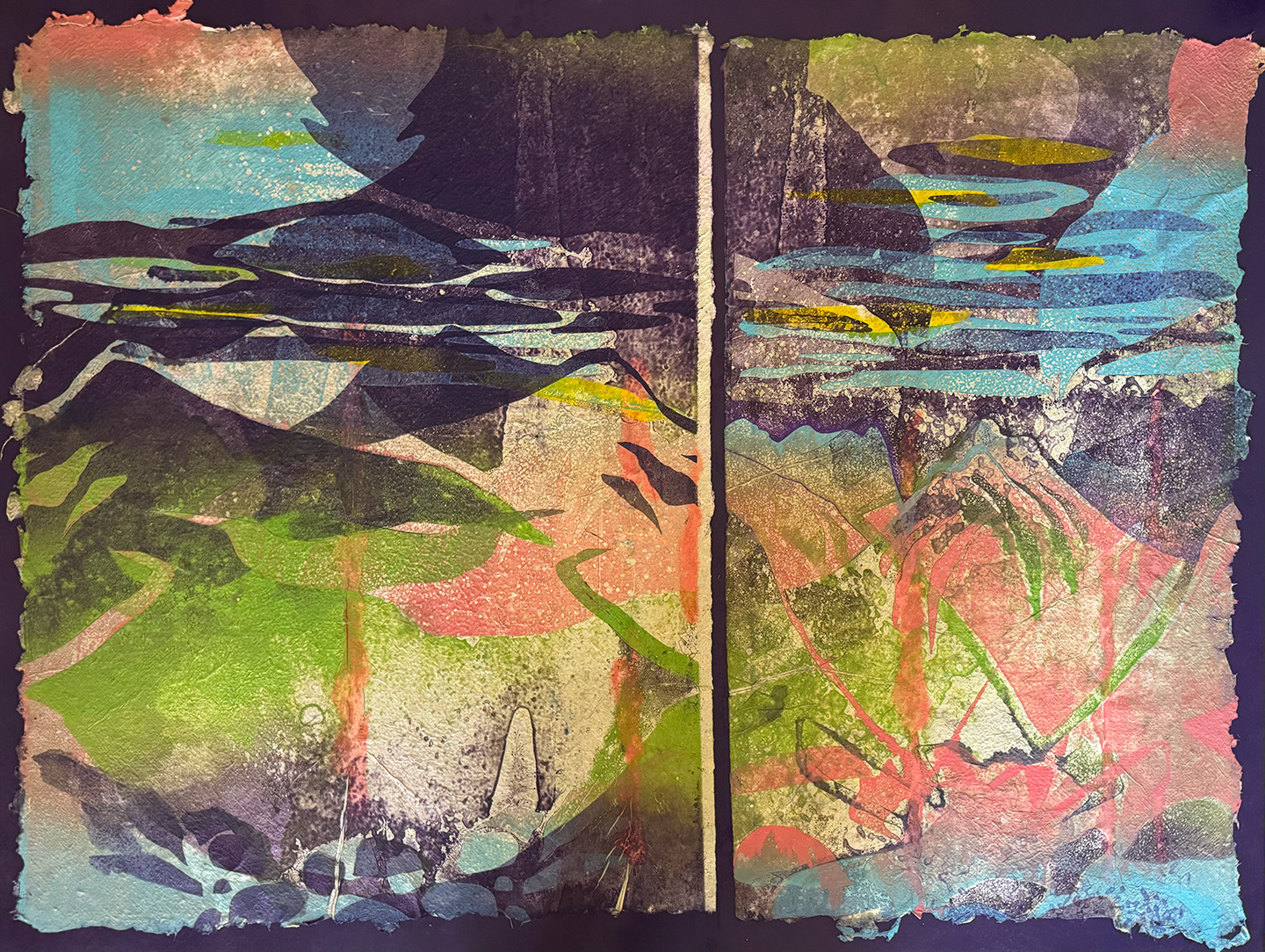
A lot of times, there's multiple landscapes in one piece, or there's multiple perspectives of that landscape in one piece. It’s not like a one to one ratio, even if the imagery might match a photograph I took or drawing I did. The colors are often more of my internal reflection of that, or could be something related to what I was thinking. Lately, I’ve been thinking a lot about cows and grazing, and how all of that has changed the landscape in really distinctive ways, but also how when the landscape gets left alone, how resilient it is.
I'm not necessarily just trying to make a landscape look the way it did look when I was out there, but to add some depth to it and in different ways. There's definitely a strong relationship between being outside, collecting imagery, and then coming back into the studio and producing these pieces that are both a reflection of the external landscape, but then also my internal landscape, and also maybe more of a societal landscape.
Does this art practice help you notice the landscape differently?
You know, it’s funny. Sometimes there are places I've drawn that I'll come back to, and they feel more familiar to me because I've been there and I've spent so much time staring at them and drawing them. And that's kind of an interesting way to familiarize yourself with a certain location. I do think that it imprints on you in a different way than if you were just to walk through, take a photograph, and move on. I love to go to new places, but I also like to come back to familiar places that I've made work about, and revisit them with a new or deeper understanding of them.
I noticed you often use very vibrant, bright colors in your work – the desert is colorful when you look closely, but this saturation of color is an interesting choice when many people think of this landscape as full of browns, muted greens. Tell me about your color choices.
A lot of the colors are colors that I do see in the landscape – and you might not see them in the middle of the day, but if you are looking at the right time, you can see all of them. Some of the colors are coming from thoughts about human intervention in the landscape - human activities have created all these synthetic colors. Synthetic colors can be a way to sort of express those thoughts or feelings about how the landscape is being affected.
The other thing is those colors mirror a little bit the way I feel about the places. There's an intensity to the experience of being in those places. In my mind, they're taking on those feelings of overwhelming beauty or overwhelming tragedy, or a combination of the two at the same time. There’s a lot of different ways the color can be interpreted or used, but it is definitely an important part of the visual representation aspect of the pieces.
What is the role of art in conservation?
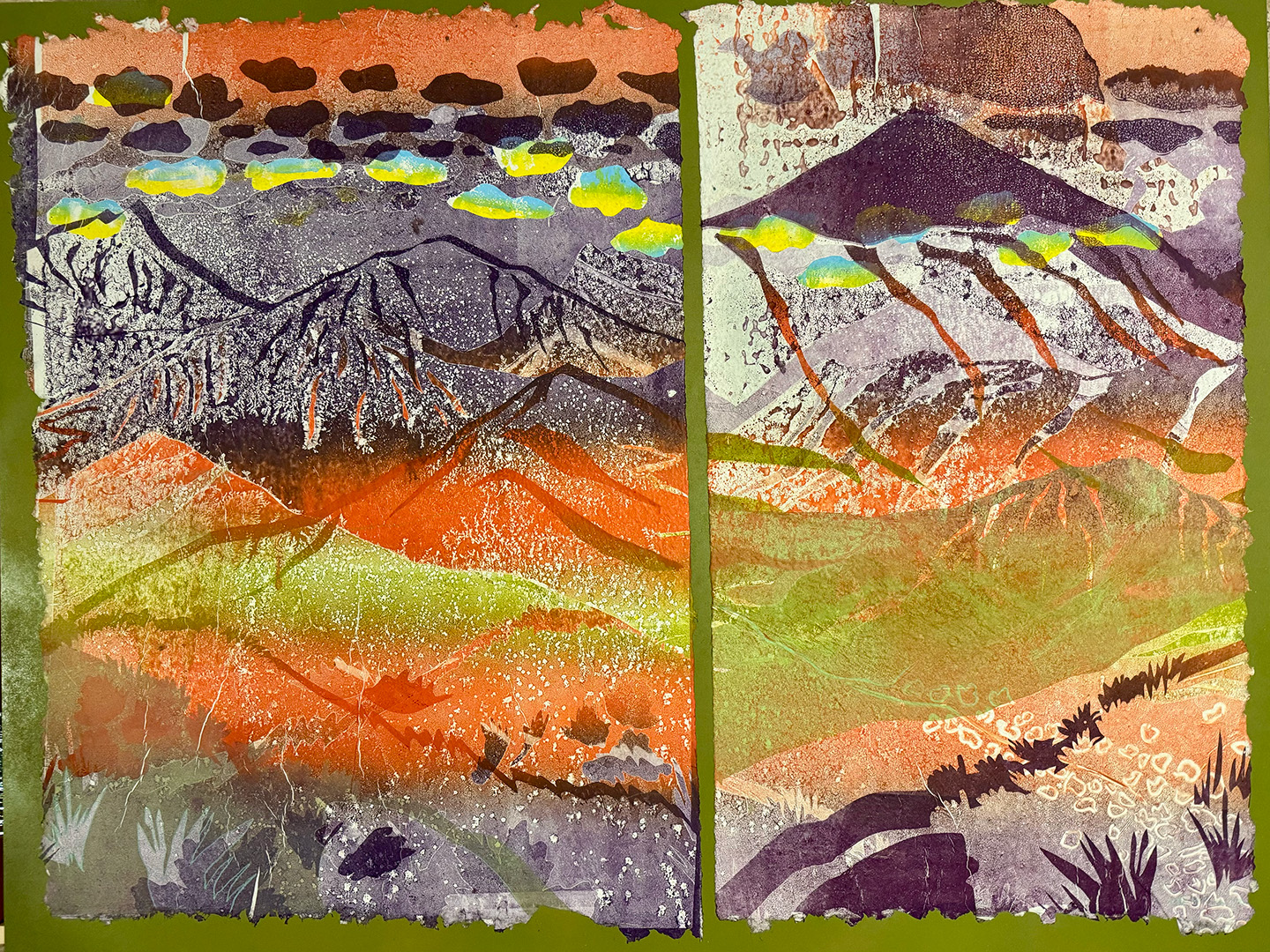
What I've been thinking a little bit about is an artist’s role is to show what isn't there, and to invite people to fall back in love with these places in a way that's personal and could come from whatever perspective. I'm not just showing what's there – what could be, in a way, is one thing I might be trying to show.
Another thing that I think about, especially living in Bluff, because it's so tiny and so removed from a lot of the day to day realities of living somewhere with a bigger population, is there's this idea that art is just life, and life is art, and it's all mixed together and is like one thing and it's not actually separated. There's a reason it's called a practice, because you have to practice to get better. And it can be for everyone, and it can be in all these different aspects.
For me, I think a big part of my practice, too, is teaching – teaching people how to make paper and showing people that you can go out into the landscape and collect these plants that are potentially harmful to other plants or animals or to the rivers ecosystem, and take them out, remove them from the system in a way that's not poisonous or damaging, and make something really beautiful and useful out of them.
That's something that's cool about living here, art can just sort of mesh together. There's no big museums or institutions here to sort of separate art, it's all just here. It should all be mixed together, and my hope would be to show people that's possible for them as well.
There's certainly a lot of art that is being made here, and has been made over time. You can go out and look at the Ancestral Pueblo and pictographs and petroglyphs and you see the pot sherds. Art has been made here for a long, long time, and it's an honor to be a part of that contemporary time.
What are you currently working on?
Right now, I'm an artist in residence at the Dugout Ranch with a friend of mine, Brooke Osborn – we worked together in grad school: she was at Brown and I was at Rhode Island School of Design. She's a soil scientist, and now she lives in Moab.
We're just getting started with it, but one thing she's looking at – that is really intriguing to me, and I would like to learn more about, and also try to make some work about – is, you know when you look out across the desert landscape and there's sort of all these little islands of plants, or there's a cluster of plants, and then there's a gap, and then there's another cluster of plants, and there's a gap? She's been doing research on those little clusters to see what kind of nitrogen fixing they do. One thing that she's finding out is that each little island can be totally different from the next, even though they're right next to each other, and what their capabilities are and how they're functioning to either stabilize the soil or fix nitrogen or provide shade for other plants. She's going to send me some stuff over the next couple months, and we're going to go up to the Dugout Ranch on-and-off and check things out, and just sort of start to formulate a plan for a project surrounding that.
One reason in particular to do that research, and maybe try to visualize it in an artistic way, is that the world is headed towards being mostly native arid dry lands, which is what she calls this area. And not a ton of research has been done on the soil. What's that soil gonna look like as we move towards the hotter, drier climate? It's an interesting question, and interesting things to think about, so I'm excited to work on our project with her.
Why were you interested in this residency?
Even though I'm not necessarily making work about science all the time, I do think that science that has to do with ecology and landscape is important and intriguing to me. I also think that there's ways to talk about science without just having it be a scientific paper, or presentation at a conference. To me, it's exciting to think about new ways of communicating information, and drawing people into the conversation who wouldn't necessarily be drawn in from a purely scientific or purely art perspective.
Learn more about Kate Aitchison on her website, and follow her on Instagram. You can also find Kate’s artwork for sale in the Bears Ears Education Center.